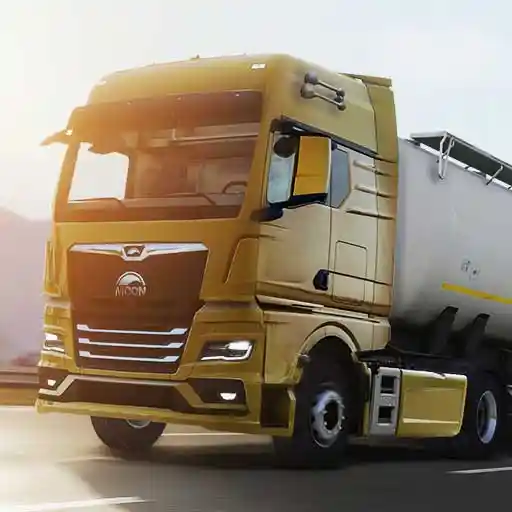
Every delivery in Truckers of Europe 3 pays, but not every delivery profits. The difference between players who stay broke and players who build a fleet is rarely driving talent. It is arithmetic: what the job pays per kilometre, what fuel and damage quietly subtract, and whether the truck doing the work belongs to you or to an employer.
The good news is that the economy rewards exactly the habits the game teaches everywhere else. Smooth driving protects cargo value, planned routes cut wasted fuel, and owning your equipment multiplies what each kilometre is worth. Money in this game is a scoreboard for good trucking.
This guide lays out the whole system, from reading the job board properly to the order in which to buy a truck and trailer. The Truckers of Europe 3 APK download page on the homepage covers installation and the full feature list if you are still setting the game up.
Pay Per Kilometre Is the Real Number
The job board shows a headline payment, and beginners sort by it. Divide that payment by the route distance and the board changes completely: some impressive long jobs pay poorly for every kilometre they consume, while modest short jobs quietly offer the best rate in the game and finish before anything can go wrong.
Time matters as much as distance. A high rate job you complete cleanly in fifteen minutes beats a higher headline job that takes forty minutes and ends with a damage bill. Think of your income as earnings per hour of play, and choose the work that respects your time.
- Divide pay by distance
- Value your playing hour
- Short jobs can pay best
- Clean finishes protect profit
The Three Costs That Eat Profit
Fuel is the visible cost: heavy loads, high speed and aggressive acceleration all drink more, and every litre comes off the job. Damage is the second cost, charged through repairs and reduced cargo payment. The third cost is invisible: time spent recovering from mistakes, detours and parking struggles that could have gone to another delivery.
You cannot remove these costs, but you can shrink all three with the same behaviour: steady pace, planned fuel, early braking and calm parking. That is why the richest players in this game look boring to watch. Their profit is in what never happens.
- Fuel scales with aggression
- Damage hits twice
- Lost time is a cost
- Steady driving shrinks all three
Working for Hire Versus Owning
Hired work is the safe apprenticeship: the employer provides the truck, and your payment is a wage for the delivery. It is the right way to learn and to save, because a crash hurts your pride and the job time, not your bank balance and a repair bill on your own machine.
Ownership changes the maths completely. Driving your own truck on freight work keeps the full job value in your hands, minus your own fuel and repairs. The same route that paid a wage as a hired driver becomes the foundation of a business once the truck, and later the trailer, are yours.
- Hired work is safe learning
- Save during the apprenticeship
- Ownership keeps full job value
- Owners pay their own costs
Buying Your First Truck Without Going Broke
The classic first purchase mistake is spending everything on the truck itself. The purchase price is only the entry fee: you still need fuel money, a repair reserve, and the patience to survive a bad day. Buy the truck when you can afford the truck plus a working float, not a moment sooner.
Choose versatility for the first machine. A balanced truck that handles most cargo classes respectably will earn every day, while a specialised flagship sits idle waiting for its perfect job. Resale and upgrade paths mean your first truck is a stepping stone, not a marriage.
- Keep a working float
- Repair reserve is mandatory
- Versatility earns daily
- First truck is a stepping stone
When to Buy a Trailer
A trailer is the second big unlock. Pulling your own trailer on your own truck captures the full value chain of a delivery, and certain cargo classes only open up properly once you own the matching trailer type. It is the point where the game stops being a job and starts being a company.
Sequence matters, though. A trailer bought too early, before the truck is earning reliably, ties up cash you need for running costs. The healthy order is truck first, a few weeks of profitable freight work, then the trailer your most common cargo actually needs.
- Trailer completes the value chain
- Match trailer to your cargo
- Truck first, trailer second
- Do not starve running costs
Route Habits That Compound
Profitable drivers think one job ahead. Before accepting a delivery, glance at where it ends: a destination with a busy job board lets you chain straight into the next load, while a remote drop can leave you driving empty kilometres that pay nothing and still burn fuel.
Backhauls are the quiet secret of the economy. Even an average paying load out of a remote town beats an empty return, because the fuel and time were being spent anyway. Drivers who chain jobs and backhaul consistently can out-earn faster drivers who only ever chase headline payments.
- Check the destination board
- Chain jobs without gaps
- Take backhauls over empty returns
- Empty kilometres still cost fuel
The Weekly Review Habit
Businesses run on review, and yours should too. Once a week, look at what you actually earned and where it leaked: which jobs paid best per hour, which deliveries lost money to damage, how much fuel the aggressive days drank. The numbers tell a story your memory edits, because memory remembers the headline payments and forgets the repair bills.
Act on one leak per week. A driver who fixes a single recurring cost, the corner they always scrape, the route family that always strands them, improves their income more reliably than a driver who overhauls everything and sustains nothing. Compounding applies to habits exactly as it applies to money.
- Review earnings weekly
- Memory edits, numbers do not
- Fix one leak per week
- Habits compound too
Saving Targets That Motivate
Vague saving fails; named saving works. Give every pool of money a job and a finish line: the truck fund at a specific number, the repair reserve at a specific number, the trailer fund after that. Watching a named fund complete is one of the game's quiet pleasures, and it converts a hundred small decisions into one visible direction.
Protect the funds from each other. The classic collapse is raiding the repair reserve for a cosmetic treat, then meeting the repair. Funds are boring right up until the day they save the business, which is the day you understand why they existed.
- Name every fund
- Finish lines motivate
- Never raid the reserve
- Boring until it saves you
Reading a Bad Week Correctly
Every career has a bad week: a destroyed load, a repair pile up, a chain of poor boards. The accounting matters less than the interpretation. A bad week caused by one mistake you have now fixed is tuition. A bad week caused by a habit is a bill that will return. Telling those two apart is the whole skill of staying profitable long term.
Never respond to a bad week by gambling: the desperate long job, taken tired, in a truck overdue for repair, is how one bad week becomes two. Respond with the boring medicine instead: short clean jobs, rebuilt reserve, confidence restored by evidence.
- Tuition versus habit
- One mistake is a lesson
- Never gamble the recovery
- Boring medicine works
Income Versus Wealth in the Game
There is a difference between earning well and becoming wealthy, and Truckers of Europe 3 models it faithfully. Income is a flow: this week's deliveries. Wealth is a stock: the trucks, trailers and reserves that keep producing income on your worst weeks and your busiest ones alike. Players who feel rich while spending every flow as it arrives discover the difference during their first breakdown.
The conversion habit is simple and unglamorous: a fixed share of every clean week moves into assets or reserves before any spending happens. Automate the decision by making it a rule rather than a mood, because moods are unreliable accountants. Over a season, that single rule is the entire difference between a driver and a business.
- Flow versus stock
- Fixed share to assets
- Rules beat moods
- Driver into business
Spending Wisely on Upgrades and Customisation
Money has two jobs in this game: looking good and earning more. Customisation is part of the fun and nobody should skip it entirely, but the order matters. Upgrades that improve the working truck, its capability and reliability, pay you back on every route. Pure cosmetics pay you back in enjoyment only.
A sensible rhythm is to fund one working improvement for every cosmetic treat. That way the fleet keeps getting more capable while it slowly becomes yours visually, and you never find yourself admiring a beautiful truck that cannot afford fuel for the job it just accepted. Drivers who want the companion treatment of this side of the game will find it in our cargo delivery guide and the career progression guide.
- Working upgrades pay back
- Cosmetics are for joy
- Alternate the spending
- Never strand the truck unfuelled